Ireland · Last reviewed 11 September 2026
Beautiful places to visit in Ireland: the best sites, county by county
Most lists of beautiful places in Ireland are ranked, and ranking them is the least useful thing you can do with them. Which of these places to visit in Ireland is best depends entirely on where you are starting and how many days you have, so this page is arranged by county instead.
Read it as a menu rather than a league table. The best places to visit in Ireland for a week on the west coast are not the ones worth two days out of Dublin, and pretending otherwise is what makes ranked lists useless.
What each entry tries to give you is the thing a photograph cannot: how long it takes, how busy it gets, and whether it is worth the detour from wherever you already are.
Plate IThe best places to visit in Ireland: the western counties
The western counties carry most of what people actually travel for, and they reward depth over breadth. Four counties, each genuinely different from the others.
Slieve League
Sea cliffs several times the height of the better-known ones in Clare, reached by a narrow road and a walk, with a fraction of the visitors. On a clear day it is the most dramatic thing on the Irish coast. On a bad day you will see cloud, which is the trade.
Half a day. Donegal is remote enough that this is rarely a detour.
Keem Bay, Achill Island
A horseshoe of white sand under a headland at the end of a cliff road on Achill. The island is reached by bridge, so no ferry timing to manage, and the road out to Keem is itself the reason to go.
A day with the island. The best beach in the country.
Connemara and the Aran Islands
Bog, quartzite and lakes, with Connemara National Park and Kylemore Abbey as the anchors. Ferries to the Aran Islands run from Rossaveal and, in season, Doolin in Clare. Inis Mór is the largest and busiest; Inis Meáin is the quiet one.
Two days for Connemara, a third for an island.
The Burren and the Cliffs of Moher
The southern end of the route is the part most itineraries never reach: Cork and the south coast covers the harbour, Kinsale and the three west Cork peninsulas, and it is where the Wild Atlantic Way actually begins.
The same limestone continues out to sea as the Aran Islands, and the Aran Islands guide covers the crossing from Doolin beneath the cliffs and which of the three is worth the day.
The Burren is a limestone pavement carrying alpine and Mediterranean plants side by side, with no equivalent elsewhere in the country, and it is the more interesting of the two. The cliffs are spectacular and crowded; go early or late.
A day for both. Easiest of all the western counties to reach from Shannon.
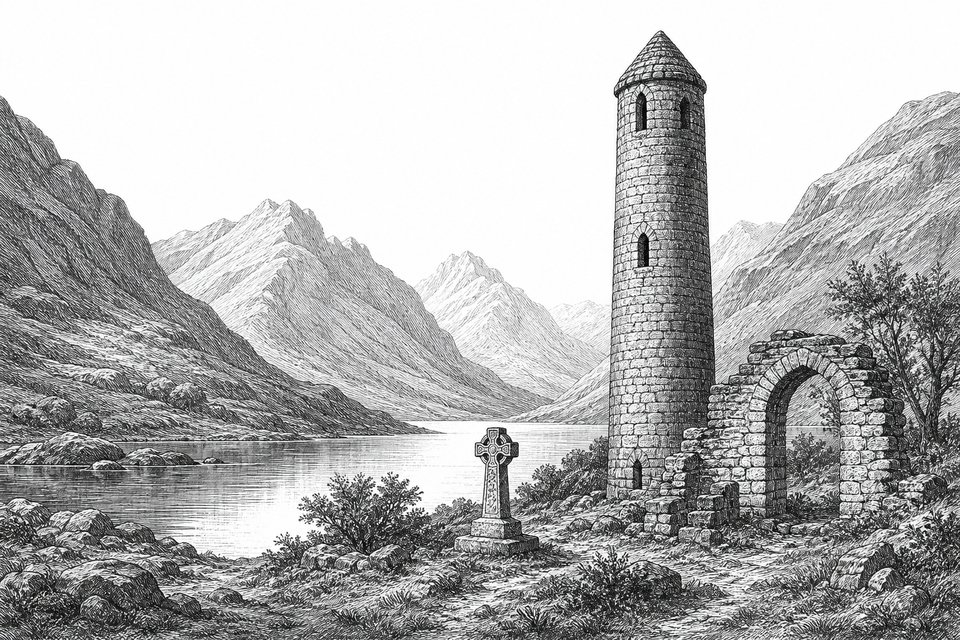
Plate IIKerry and Cork: the most beautiful peninsulas in either county
The southwest has the highest concentration of beautiful places in Ireland and the highest concentration of traffic to match. The peninsulas are the point, and there are more of them than the famous two.
The Dingle Peninsula is the one to choose if you can only do one. The Slea Head drive is a loop of about fifty kilometres with archaeology, cliffs and beaches stacked on top of each other, and Dingle town is a genuinely good base rather than a service stop.
The Ring of Kerry is the famous circuit around the Iveragh Peninsula. It is beautiful and it is busy, and coach traffic runs it in one direction, which is worth knowing before you set off the other way. Killarney National Park at its eastern end is the best of it for anyone who would rather walk than drive.
Beara and Sheep's Head are the quieter peninsulas further south, in Cork and partly in Kerry. Less infrastructure, fewer coaches, and for many people a better day than the Ring.
Skellig Michael sits off the Kerry coast and is the one entry on this page you cannot simply turn up for. Landings run in summer only, are strictly limited, and are cancelled routinely in poor sea conditions. Book well ahead and hold the day loosely.
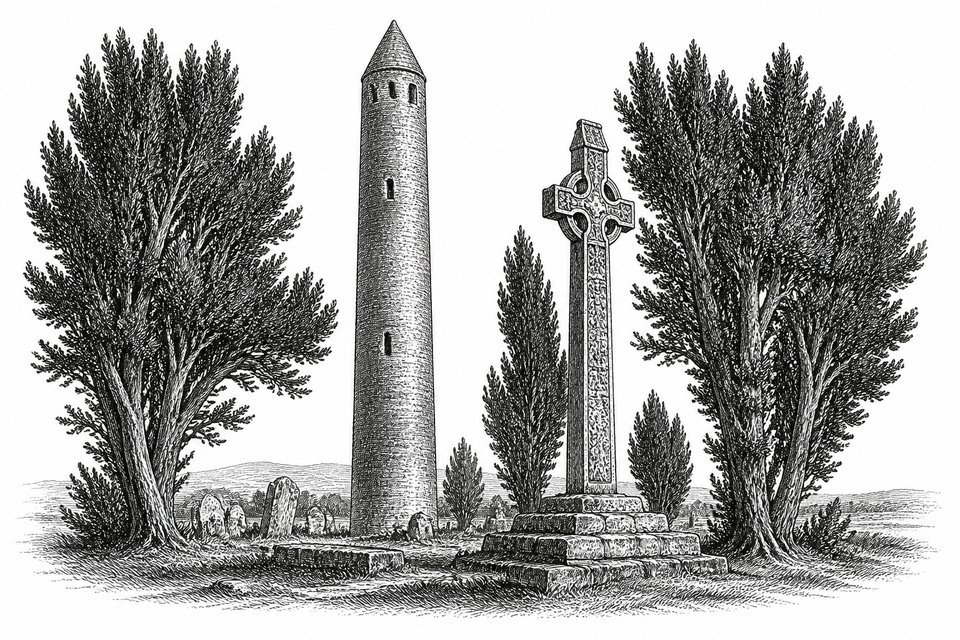
Plate IIIThe eastern counties, and what a short trip should do
If you are in Dublin with two or three days, driving west is usually the wrong call. The east has the country's deepest history within an hour or two of the capital.
Newgrange in the Boyne Valley, County Meath, predates the pyramids at Giza. Its alignment with the winter solstice sunrise is why it is famous, and access to the chamber is by guided tour from the visitor centre rather than directly at the mound.
Glendalough in County Wicklow is an early monastic settlement in a glacial valley with two lakes, an hour from Dublin and walkable in several directions. It is the single best day trip from the capital.
The Rock of Cashel in County Tipperary is a medieval complex on a limestone outcrop visible for miles, and it is on the natural line between Dublin and Cork rather than a detour from it.
Kilkenny has the best-preserved medieval core of any Irish town and works as an overnight stop rather than an hour's walk.
Plate IVWhat gets left off, and why
A list is defined as much by its omissions as by its entries, so here are the ones people ask about.
The Blarney Stone is a queue. The castle and gardens around it are pleasant and the stone itself is a twenty-minute wait to lie on your back over a gap in a parapet. It appears on every ranking of the best places to visit in Ireland and it earns that place through recognition rather than through the experience.
The Ring of Kerry is on this page but with a caveat rather than a recommendation, because the Dingle Peninsula next door delivers a similar landscape with a fraction of the coach traffic. If you have one day in Kerry, Dingle is the better use of it.
The Cliffs of Moher are genuinely spectacular and genuinely oversubscribed. Nothing about the cliffs disappoints; the experience of visiting them between eleven and four in July does. Slieve League is higher and emptier, and the Burren beside the cliffs is more unusual than either.
Temple Bar is not a beautiful place in Ireland, it is a district in Dublin with high drink prices, and it is included here only because it is the single most common thing visitors are disappointed by. The pubs worth walking to are two streets in any direction from it.
The pattern behind all four is the same. The most photographed sites are not the most rewarding ones; they are the ones with the best car parks. Almost every entry in the western counties above is quieter than its reputation would suggest, and the two that are not are the two everybody names first.
Plate VWhen each county is at its best
Ireland's temperature barely moves across the year, so the season question is really about daylight, crowds and what is open.
June gives the longest days, and in the far northwest the light holds until around eleven at night, which effectively adds a day to a week. Donegal and Mayo benefit from that more than anywhere else, because their attractions are outdoors and unticketed.
September is the best compromise almost everywhere. Sea temperatures peak, the coastal crowds thin out after the Irish school holidays end, and most seasonal operations are still running. If there is a single month to pick for the best places to visit in Ireland on the west coast, this is it.
October to March closes a great deal on the coast: island ferries reduce or stop, smaller visitor centres shut, and the Skellig landings do not run at all. What opens up instead is the east, where Newgrange, Glendalough and Kilkenny are year-round propositions and are noticeably better without summer coach traffic.
Plate VIGetting to these places to visit in Ireland
Almost all of these places to visit in Ireland need a car. Public transport serves the cities well and the coastal routes barely at all, so the realistic alternatives to driving are day tours from Dublin, Galway, Killarney or Cork. Which airport you land at narrows the list more than most visitors expect, and the airport guide sets out which one serves which coast. If the car is the plan, so does driving in Ireland, which is where the road classes and the realistic average speeds are.
Day tours are better than their reputation for the harder-to-reach places. A coach to the Cliffs of Moher from Galway removes the parking problem entirely, and a guided boat to Skellig Michael is the only way to get there at all. Where they fall down is flexibility: a tour arrives when it arrives, which on this coast frequently means arriving in the one hour of the day when the weather is wrong.
Distances take longer than they look. The working rule is to take whatever a mapping app says and add half again, because the R-classified coastal roads are narrow and slow.
Parking is the quiet constraint at the famous stops between June and September. The Cliffs of Moher, Kylemore Abbey and the Giant's Causeway all have paid car parks that fill by late morning, and the overflow arrangements add a walk rather than solving anything. Arriving before ten or after four is the whole trick, and it also happens to be when the light is worth photographing.
One geographical point that affects bookings: the Giant's Causeway and the Causeway Coast are in Northern Ireland and therefore in the United Kingdom, which changes currency and mobile roaming. Everything else named on this page is in the Republic.
For how to string these into a route rather than a list, see the Wild Atlantic Way route guide, which covers how many days each section needs and the practicalities of driving in Ireland.
Common questions
What are the most beautiful places in Ireland?
Slieve League in Donegal, Keem Bay on Achill in Mayo, the Burren in Clare, the Slea Head drive on the Dingle Peninsula in Kerry and Glendalough in Wicklow would appear on most honest lists. Clare’s cliffs are the most visited rather than the most beautiful.
Which county has the best places to visit in Ireland?
Kerry has the greatest concentration and the most visitors. Donegal has the most dramatic coastline and the fewest people. Clare packs the most into the smallest area. Wicklow is the answer if you are based in Dublin and have two days.
Are the Cliffs of Moher worth it?
Yes, early or late in the day. In the middle of a summer day the car park and the path define the experience more than the cliffs do. Slieve League in Donegal is considerably higher and quieter.
Can you see the main sites without a car?
Dublin, Galway and Cork cities yes; almost nothing on the coast. Public transport does not serve the scenic routes at useful frequencies, so day tours are the realistic alternative to driving.
How much of this is in Northern Ireland?
The Giant’s Causeway and the Causeway Coast are, which puts them in the United Kingdom for currency and mobile roaming. Everything else on this page is in the Republic. The border does not interrupt a drive.