Practical · Last reviewed 11 September 2026
Driving in Ireland: roads, hire cars and road rules
The country is small and the driving is slow, and the gap between those two facts is where most itineraries go wrong.
Ireland is about the size of a large European region and takes considerably longer to cross than one. That is not a complaint about the roads, which are in good condition; it is a statement about what kind of roads they are once you leave the motorway network, which is small and does not go where the scenery is.
Almost every visitor who drives here arrives with a schedule built from distances and leaves having rebuilt it from time. This page is the version of that lesson that is cheaper to read than to learn.
Section 1Which side, and what actually differs
Ireland drives on the left. For anyone coming from Britain, Australia or New Zealand there is nothing to adjust. For everyone else, the adjustment is real but smaller than expected, and it concentrates in three places rather than being spread across the whole experience.
Roundabouts turn clockwise, you give way to traffic already on them, which comes from your right, and you signal left on the exit. They are used heavily and in preference to traffic lights, so this is the manoeuvre you will perform most often on the first day.
The car sits to your left of where you expect. Driving on the left in a right-hand-drive car means your body is near the centre line and the passenger side is near the wall. Drivers who have swapped sides consistently misjudge the left edge, which is exactly the edge that meets a stone wall on a narrow road. Wing-mirror damage is the most common claim in the west coast hire fleet, and this is why.
Turning across traffic is the reversal that persists. A right turn here crosses the oncoming lane, which is the manoeuvre a left-side driver performs automatically and the one that needs deliberate attention for the first few days.
Everything else transfers. The pedals are in the same order regardless of which side the steering wheel is on, and gear changing with the left hand is unfamiliar for about twenty minutes and then is not.
Section 2Reading a road from its number
The letter in front of a road number tells you almost everything about how long the journey will take, and it is the single most useful thing to learn before planning a route. Distance on the map does not predict time here. Road class does.
Irish road classes, what each is like to drive, and the realistic average speed to plan a route with.
| Class | What it is | Plan at | Where you meet it |
|---|---|---|---|
| M | Motorway, dual carriageway, grade separated | 110 km/h | Radiating from Dublin |
| N | National road, mostly single carriageway | 70 to 80 km/h | Between towns and cities |
| R | Regional road, two lanes, often no markings | 50 to 60 km/h | Most of the scenic coast |
| L | Local road, frequently single track | 30 to 40 km/h | Peninsulas, islands, the last mile |
The gap between the posted limit and the plannable average is where itineraries fail. A regional road may be signed at 80 km/h and it is not a target; it is the maximum the law permits on a road where 55 is the sensible sustained speed and where you will stop for oncoming traffic, for a tractor, and twice for sheep.
A useful rule for the west: take the distance in kilometres, divide by fifty, and add half an hour for every hour that produces. It sounds pessimistic and it is close to right. The Wild Atlantic Way route guide works to the same arithmetic when it says how many days each section needs.
Section 3The narrow roads, and how they work
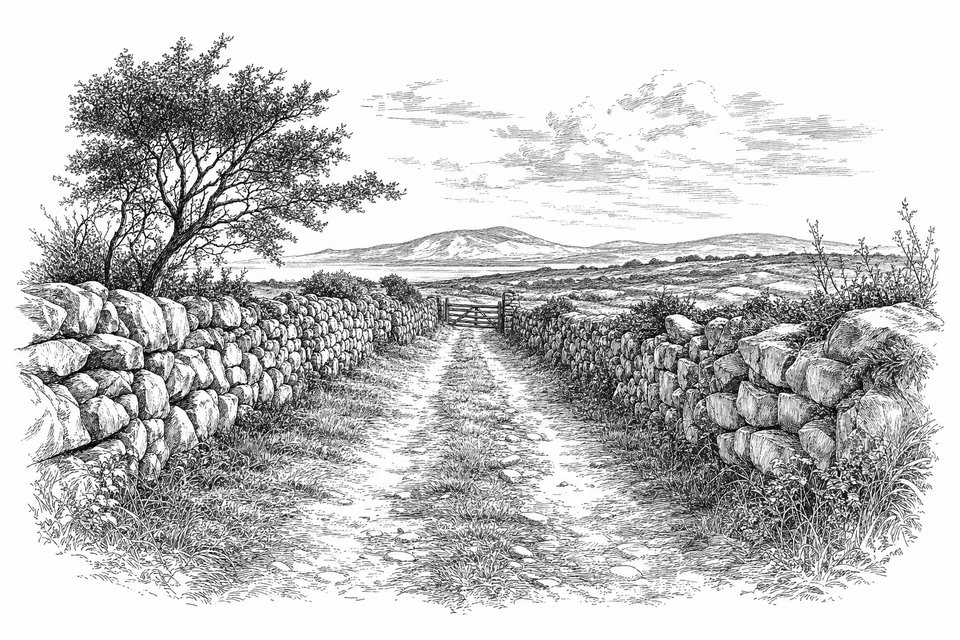
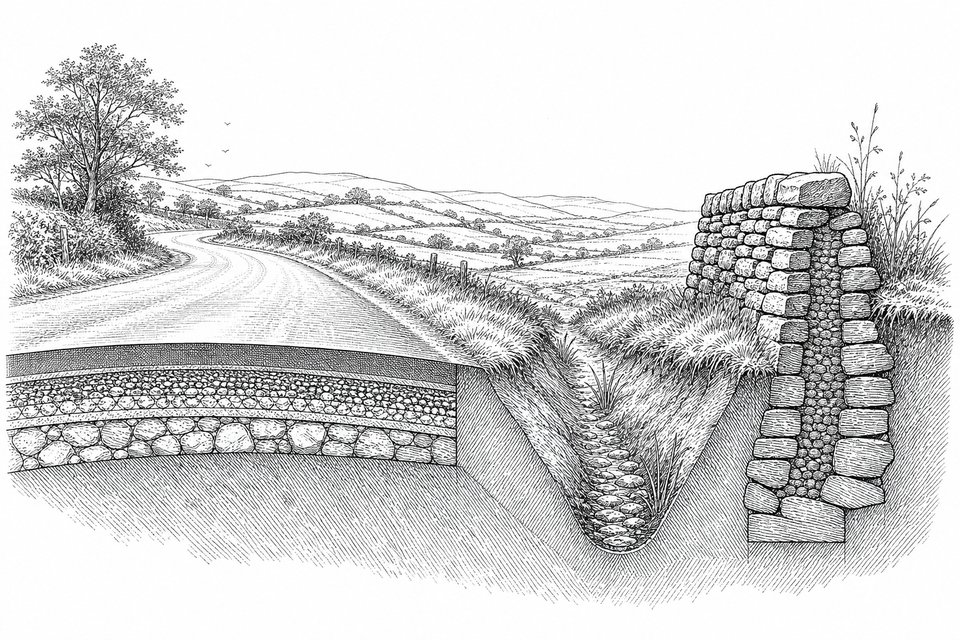
On the L network in the west, and on plenty of R roads too, the carriageway is a single lane with no centre line, bounded by a dry stone wall, an earth bank or a hedge that has been there considerably longer than the tarmac. There is no verge. There is nowhere to put a wheel that is not the road.
This is not a hazard so much as a different system, and it has conventions. Passing happens at gateways, field entrances and the occasional widened section, and both drivers are looking ahead for the next one rather than for each other. Someone reverses; it is usually whoever is nearer a passing place, and it is done without ceremony. A raised index finger off the steering wheel is the acknowledgement. None of this is written down and all of it is universal.
Three things make it easier immediately. Drive slower than feels necessary, because the sight lines are shorter than they appear and the thing around the bend is frequently stationary. Keep left but not against the wall, since the wall does not move and the damage is always to the mirror. And treat the middle of the lane as normal on a road with no markings, moving left only when there is something to move for.
The one genuinely new hazard for most visitors is livestock. Sheep on an unfenced mountain road are not an anecdote, they are a Tuesday, and they do not move for a horn. They move for patience.
Section 4Hiring a car without the three usual surprises
Automatics are scarce. The Irish fleet is predominantly manual, the automatics cost more, and in July and August they are gone. Anyone who cannot drive a manual should book months ahead and treat the booking as the fixed point of the trip. Arriving to choose is how a holiday starts with a two-hundred-kilometre lesson.
The excess is the real price. Irish hire insurance conventionally carries a substantial excess, and the counter will offer to reduce it at a daily rate that can approach the rental itself over two weeks. There are three routes through this: accept the excess and carry the risk, buy the counter's reduction, or hold a separate excess policy bought independently, which is generally the cheapest and requires you to pay first and reclaim. Whichever you pick, read what the excess actually is before arriving, because the number is the thing being negotiated and it is rarely on the headline page.
The credit card must be yours, in your name, with a real limit. Most companies place a hold for the excess amount, they generally will not accept a debit card for it, and the card must belong to the named driver. This is the most common reason a booked car is not released at the desk.
Two smaller ones worth knowing. Cross-border travel into Northern Ireland is normally permitted but must be declared, because the insurance follows the declaration rather than the border, which is invisible. And the size of car that seems sensible on a booking page is usually one class too big for an L road; the smaller car is the more comfortable choice on the roads you came to drive.
Section 5Signs, limits and the place names
Speed limits are in kilometres per hour and have been since 2005. Distance signs are metric too. The confusion that survives is the occasional old black and white local sign still in miles, and a hire car dashboard that is unambiguous. If a number looks implausible for the road, it is a sign from an earlier system, not an invitation.
Place names appear in both Irish and English on most signs, with the Irish above. In the Gaeltacht areas of Donegal, Connemara, Kerry and west Cork, they legally appear in Irish only, and this is the one signage feature that genuinely disorients visitors. The village your map calls Dingle is signed An Daingean; Galway city on a Connemara approach is Gaillimh. Anyone driving the western coast should carry both names for the places they are heading to, because the satellite navigation and the sign will not always agree.
Two conventions that catch people. A yellow box junction must be entered only when the exit is clear. And the hard shoulder on a national road is used by slower traffic to let faster traffic past, which is normal here and looks like an invitation to undertake, and is not one.
Section 6Tolls, fuel and parking
Most Irish tolls are ordinary barrier plazas: you stop, you pay, you go. The exception is the one every visitor meets, and it is the M50 around Dublin.
The M50 is barrier-free. There is no booth. Cameras read the plate and nothing whatsoever happens as you drive through, which is precisely the problem: a driver who does not know the charge exists has no way of discovering it from the road. It must be settled separately within the window the operator sets, and an unpaid one escalates rather than expiring.
The practical instruction is one question at the hire desk, before leaving the car park: how does this company handle the M50, and what will I be charged for it. Some vehicles are registered to an account and the toll appears on the final bill with an administration fee. Some are not, and paying is the driver's job. Both are normal; not knowing which one you have is the expensive option.
Fuel is sold by the litre and diesel is common in the hire fleet, which matters at the pump because the nozzles are adjacent and the mistake is expensive. In the west, filling stations thin out considerably: on a peninsula road, half a tank is the point to start looking rather than the point to relax.
Parking in the cities is metered and enforced, and in the towns is frequently a pay-and-display disc bought in a shop rather than a machine on the street. At the well-known coastal sites parking is the constraint that decides the visit: arriving at the Cliffs of Moher or the Gap of Dunloe in the middle of a July day is arriving after the car park filled. The guide to the coastal sites is organised partly around that fact.
Section 7Weather and light, which set the driving day
Irish weather is less extreme than its reputation and more frequent. Rain arrives in bands rather than settling, so a wet morning is a poor predictor of a wet afternoon, and the correct response on a driving day is to continue rather than to rearrange. What it does change is the road surface, and a wet R road with a stone wall on the left deserves the same speed reduction a much worse-looking road would get elsewhere.
Light is the real constraint and it is seasonal to a degree that surprises people from further south. In late December the usable day is short enough that a single scenic section is the whole day's driving; in June it runs long enough that the same section can be done after dinner. That swing is the reason the route guide counts daylight rather than distance when it says how much of the coast fits in a day.
Two conditions genuinely worth respecting. Coastal wind on an exposed causeway or bridge moves a small car, and the gusts arrive in gaps between headlands rather than steadily. And low sun on a west-facing road in the late afternoon, on wet tarmac, removes the road entirely for a few seconds at a time. Sunglasses are not a luxury item on the Wild Atlantic Way; they are equipment.
For where to point the car once it is hired, the Wild Atlantic Way route guide covers the sections and how many days each needs, and flying from Ireland covers which airport to collect it at.
Common questions
Which side of the road does Ireland drive on?
The left, as in the United Kingdom, Australia and New Zealand. Hire cars are right-hand drive, so the gear lever is at your left hand and the pedals are in the usual order. The two things drivers from the right actually get wrong are roundabouts, which go clockwise, and judging the left-hand edge of a car they are not used to.
Are Irish speed limits in miles or kilometres?
Kilometres per hour, and have been since 2005. Distances on green and white signs are in kilometres too. Older black and white local signs sometimes survive in miles, and a hire car speedometer will read km/h, so the mismatch is usually a sign rather than an instrument.
How narrow are the roads really?
On the regional and local network in the west, genuinely single track for long stretches, with stone walls or hedges hard against both edges and no verge to use. Passing is done at gateways and lay-bys, by arrangement with the oncoming driver. This is normal rather than exceptional and it is the main reason a route takes longer than a map suggests.
Do I need an automatic hire car?
Only if you cannot drive a manual, but book it early if so. Automatics are a minority of the Irish hire fleet, they cost noticeably more, and in high season they run out. Turning up expecting to choose is the way this goes wrong.
What is the M50 toll and why do people get caught by it?
The M50 around Dublin is barrier-free. There is no booth to stop at and nothing happens as you pass, so a visitor drives through without knowing there was a charge. It must be paid separately by the deadline set by the operator, or it escalates. Ask the hire company how their vehicles handle it before leaving the car park, because the answer differs by company.
Is it worth driving rather than taking tours?
For the coast, yes, and the alternative is thin. Public transport serves the cities well and the scenic routes barely at all. Day tours from Dublin, Galway, Killarney or Cork are the realistic substitute, and they are better than their reputation for the harder-to-reach places, but they set the timetable.