Destinations · Last reviewed 11 September 2026
The Aran Islands: ferries, seasons and which one to pick
Three islands, two piers and one timetable that decides the shape of the entire day.
The Aran Islands lie across the mouth of Galway Bay, close enough to the Clare and Connemara coasts to be visible from both and far enough out that the crossing is a sea crossing rather than an estuary hop. They are limestone, continuous with the Burren geologically, and they carry a field system of drystone walls dense enough to be visible from the air as a pattern rather than as fences.
They are also inhabited, working communities with schools, shops and a lifeline ferry, which is the fact that makes them navigable out of season while most Irish island trips are not. Everything practical below follows from where you sail from and what month it is.
Section 1Three islands, not one
"The Aran Islands" is often used as though it were a single destination and it is three, with genuinely different characters and different reasons to choose them. Getting this wrong is the most common way a visit disappoints, because the island that suits a photographer does not suit someone who wanted an afternoon of quiet walking.
The three Aran Islands, with the realistic reason to choose each and how long it takes to see.
| Island | Scale | Go for | Getting round |
|---|---|---|---|
| Inis Mór | Largest of the three | The cliff fort, the most to see | Bicycle or minibus tour |
| Inis Meáin | Middle, least visited | Quiet, and very little else | On foot |
| Inis Oírr | Smallest | An afternoon, walkable end to end | On foot or bicycle |
The largest takes the great majority of visitors and has the infrastructure that follows from it: bicycle hire at the pier, minibus drivers meeting the boat, places to eat, and accommodation in more than one village. Inis Oírr has a fraction of that and is the better choice for anyone whose plan is to walk somewhere and sit down. Inis Meáin has least of all, deliberately, and it is the island people return to rather than the one they start with.
Section 2The two piers, and why the choice matters
There are two mainland departure points and they are not interchangeable.
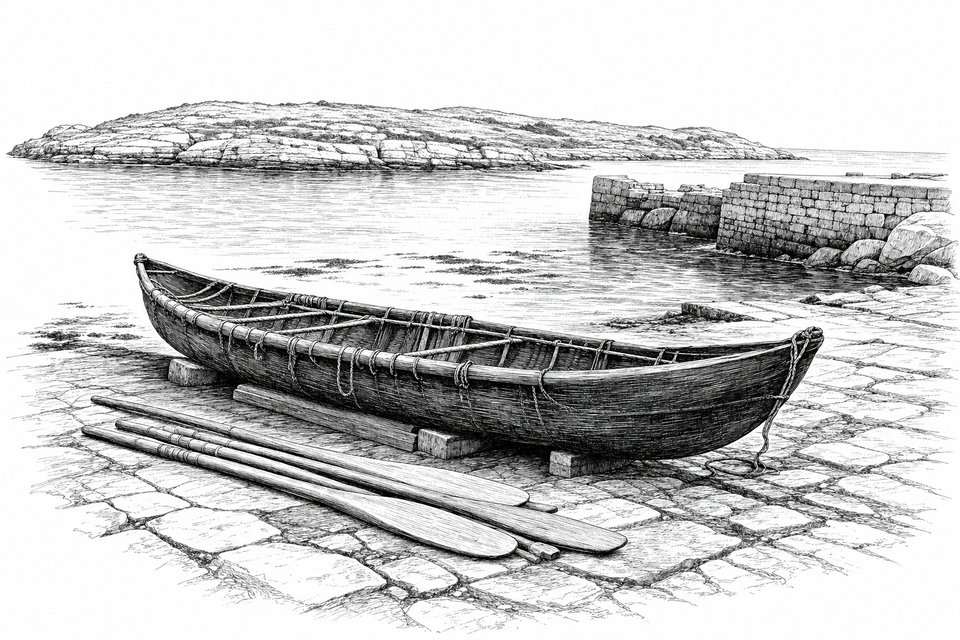
Rossaveal, Ros an Mhíl, sits on the Connemara coast west of Galway city and operates all year. It is the islands' own connection to the mainland, which is the reason it does: the service exists for residents first and visitors second, and a route that carries schoolchildren and groceries does not close for the winter. The crossing is the shorter of the two and coach transfers run from Galway to meet the sailings, which is how most day visitors without a car use it.
Doolin, in County Clare, is the seasonal option. It sits directly below the Cliffs of Moher and is the obvious choice for anyone already on the Clare coast, since it removes the drive around Galway Bay entirely. It also offers something Rossaveal cannot: the sailing passes beneath the cliffs, so the crossing is itself part of what you came to see. The trade is that it reduces or stops over the winter, and that Doolin's harbour is more exposed, so a cancellation for weather is likelier there.
The rule that follows is simple enough to plan around. If the trip is in the summer and you are in Clare, sail from Doolin. If the trip is outside the season, or the trip must happen on a particular day, sail from Rossaveal.
Section 3What the ferry season actually means
"Seasonal" is doing a lot of work in most descriptions of Irish island transport, and it covers three separate things that are worth separating, because only one of them can be planned around.
Reduced frequency is the ordinary shoulder-season state: the boats run, there are fewer of them, and the last one back is earlier. This is the version that quietly ruins itineraries, because the trip is possible and the day is four hours shorter than the summer version it was planned as. Check the return sailing before the outbound one.
Suspended for the winter is a route not operating at all for a stretch of months. This is Doolin's winter position and, more absolutely, it is the position of the Skellig landings further south, which do not run outside their season under any circumstances.
Cancelled on the day is weather, and it is the one that applies in every month including August. A sea crossing on the Atlantic coast is contingent, and the decision is made a few hours ahead. Anyone with a flight home the following morning should not spend the night on an island, and anyone travelling out of season should treat the island as a plan that may become a different plan.
This site tracks those seasonal claims deliberately rather than writing them once and leaving them, because the pattern moves. What does not move is the structure: Rossaveal year round, Doolin in season, and the Atlantic with a veto over both.
Section 4Choosing between them
One day, first visit, want the photograph. The largest island. It has Dún Aonghasa, the prehistoric fort on the cliff edge, which is the single most arresting thing on any of the three and among the most arresting on the Irish coast. Hire a bicycle at Kilronan, take the coast road out and the inland road back.
An afternoon, and quiet is the point. The smallest of the three. The whole island is walkable, there is a beach, a wrecked freighter on the rocks, a small castle on the hill above the harbour, and not much competition for any of it.
Two or three nights, and you have been before. Inis Meáin. It is the least altered of the three and the least equipped, and both of those are the reason to go. Not a first choice, and not a day trip.
Travelling with someone who will not cycle. Inis Mór with a minibus tour, booked at the pier on arrival rather than in advance. The drivers meet the boat, the circuit takes a couple of hours, and it reaches the fort.
Section 5What is actually there
The landscape is the attraction and it is unusual rather than merely scenic. The islands are bare limestone pavement, the same formation as the Burren across the water, cracked into blocks by ancient weathering and holding almost no natural soil. The soil that exists on the farmed land was made, over centuries, from sand and seaweed carried up from the shore, and it is held in place by the walls.
Those walls are the second thing to understand. There are thousands of kilometres of them across three small islands, built without mortar, and their density is a consequence of the ground rather than a decision about boundaries: clearing a field of stone produced the stone, and the wall was where it went. They also break the wind, which on an exposed Atlantic island is what makes the field usable at all.
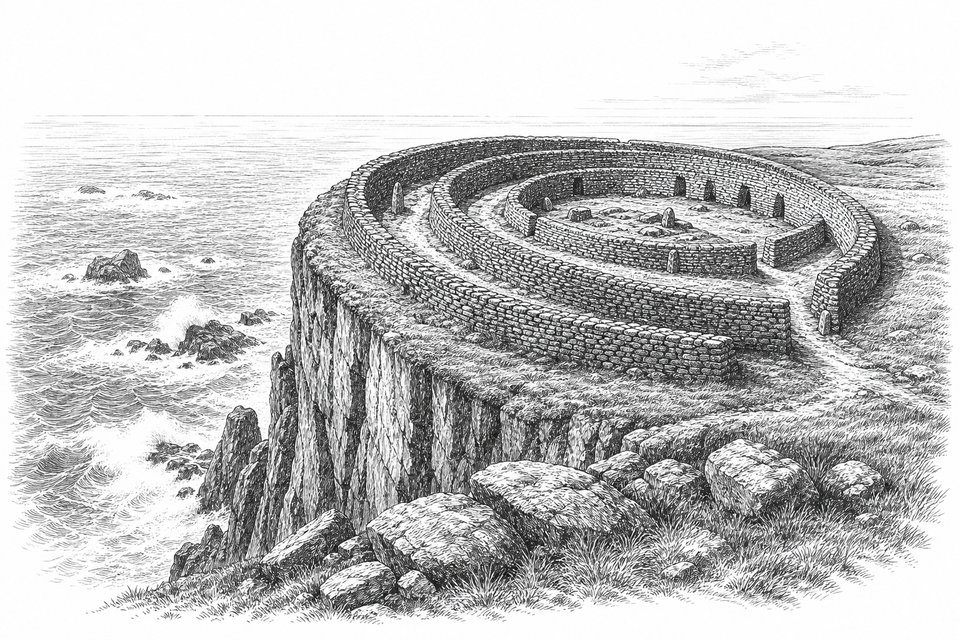
Dún Aonghasa on Inis Mór is a semicircular drystone fort of concentric walls on the lip of a cliff about ninety metres above the sea. Its landward defences include a band of upright stones set close together, which is unmistakable in purpose once you have walked through it. There is no fence at the cliff edge and no intention of one, which is worth knowing before arriving with small children or with a strong dislike of heights.
Beyond that: early Christian church sites, a lighthouse, a seal colony on the north shore of the largest island, and on the smallest the hull of the Plassey, a freighter driven onto the rocks in the 1960s and left there. The islands are also where Aran knitting comes from, and the local wool is sold on the islands themselves rather than only in the Galway shops.
Section 6A day trip, or a night
Most visits are day trips and most day trips are the right call. The islands are close enough for it and the two larger ones have enough at the pier end that a day is not rushed.
The case for a night is specific rather than general: the day visitors leave on the late-afternoon sailing, and what is left after that is the thing people describe when they talk about the islands. An evening on the smallest island with the boats gone is a different place from the same island at two in the afternoon. Accommodation is limited on all three and booked well ahead in summer.
The case against is the weather clause above. A night on an island is a night with a contingent return, and that is a poor thing to put immediately before a flight home. The same logic applies to the rest of the coast and is one reason the Wild Atlantic Way route guide puts island days in the middle of an itinerary rather than at the end of one.
Section 7The flight, which is not a novelty
There is a scheduled air service to all three islands from Connemara Airport at Inverin, west of Galway, flown in small aircraft. The crossing takes minutes rather than the best part of an hour, and for the islands it is the same lifeline function the Rossaveal ferry performs, which is why it exists at all.
For a visitor it solves two specific problems and no others. It is markedly less weather-dependent than the boat in the sense that matters, since a swell that stops a ferry does not necessarily stop a light aircraft; and it removes the sea crossing for anyone who does not want one. It costs more than the ferry, it carries very little luggage, and it does not pass beneath the Cliffs of Moher, which is a real loss if that was part of the appeal.
Worth considering seriously by anyone travelling out of season or on a fixed date. Not worth considering as an upgrade in July, when the boat is pleasant and the flight is small.
For where the islands sit in a longer coastal itinerary, see the Wild Atlantic Way route guide; for the Clare end of the crossing and the sites above Doolin, see the coastal sites guide; and for the driving between them, driving in Ireland.
Common questions
How do you get to the Aran Islands?
By ferry from Rossaveal in Connemara, which runs all year, or from Doolin in County Clare, which is seasonal. There is also a short flight from Connemara Airport. Rossaveal is the reliable option and Doolin is the convenient one if you are already on the Clare coast.
Do the ferries run in winter?
From Rossaveal, yes, all year, because the islands are inhabited and the service is a lifeline rather than a tourist route. From Doolin the sailings reduce or stop over the winter. In either case a winter crossing can be cancelled at short notice for weather, which is a different thing from not being scheduled.
Which Aran island should I visit?
Inis Mór if you have one day and want the famous cliff fort and the most to see. Inis Oírr if you want somewhere small enough to walk in an afternoon. Inis Meáin if you want the quietest of the three and are prepared for very little in the way of facilities.
Can you do the Aran Islands as a day trip?
Inis Mór and Inis Oírr comfortably, from Galway or the Clare coast, and most visitors do. The day is shaped entirely by the return sailing, which in the shoulder season can be early enough to remove several hours from the middle of it.
Do you need a car on the islands?
No, and taking one is impractical. Distances on Inis Mór suit a bicycle, which is hired at the pier, or one of the minibus tours that meet the ferry. Inis Oírr is small enough to walk. The roads are narrow walled lanes and there is nowhere to park at the far end of them.
What language is spoken on the Aran Islands?
Irish, as the everyday language of the community, and English fluently alongside it. The islands are in the Gaeltacht, so signage and place names appear in Irish, and the island names on a timetable will be Inis Mor, Inis Meain and Inis Oirr rather than their anglicised forms.