Destinations · Last reviewed 11 September 2026
Cork and the south coast: harbour towns and days out
The quietest good coastline in Ireland, and the only one where the driving is easy.
The south coast is the part of Ireland that gets skipped, and the reason is arithmetic rather than merit: a visitor with a week flies into Dublin, drives west, and runs out of days somewhere in Kerry. Cork is the far end of that route and it is where most itineraries stop rather than start.
Which is a straightforward opportunity. The scenery from Kinsale west to Mizen Head stands comparison with anything in Clare or Connemara, the harbour towns are larger and better preserved than their western equivalents, the roads are wider, and in August the car parks are not full.
Section 1Cork city, and how long it needs
Cork is Ireland's second city and it is unusually easy to read. The centre sits on an island between two channels of the River Lee, which is why the main streets curve, why several of them were waterways within living memory of the buildings on them, and why the whole thing can be walked end to end in twenty minutes.
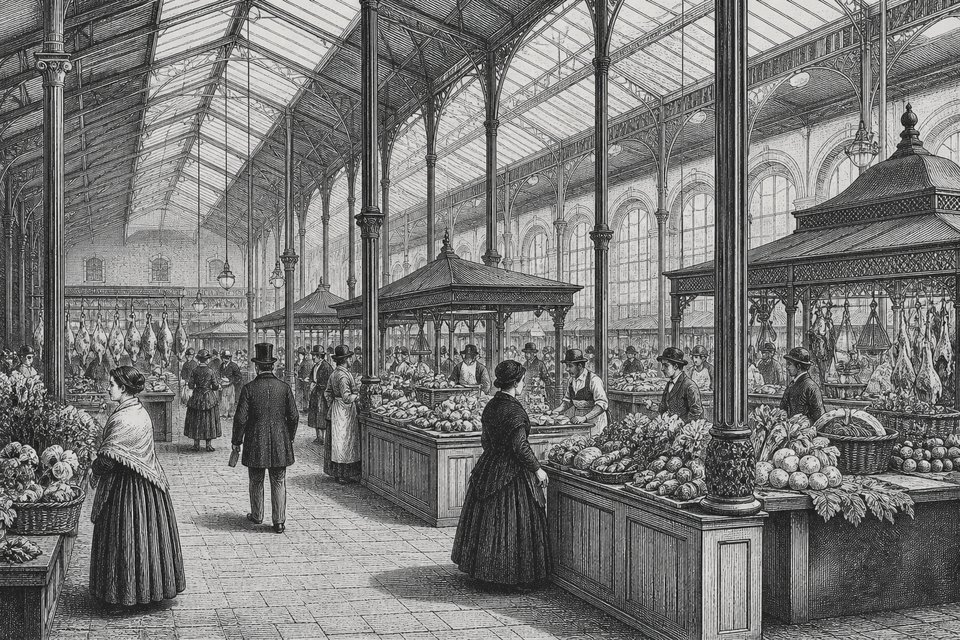
A day is enough and half a day is not unreasonable. The English Market, a covered Victorian market hall still functioning as a market rather than as a heritage exhibit, is the one thing to see if you only see one. St Anne's Church, on the hill north of the river, has a tower you can climb and bells that visitors are permitted to ring themselves, which is a rarer thing than it sounds and audible across the city while you are doing it.
The city's real function on a south coast trip is as a base. It has the airport, the rail connection to Dublin, the widest choice of accommodation on the coast, and everything described below within an hour and a half of it. A visitor staying two nights in Cork can reach the harbour, Kinsale and the near part of west Cork without moving hotels, which is not true of any base further west.
Blarney is fifteen minutes out and is the one item on the south coast where expectation and reality diverge sharply. The castle and its grounds are genuinely good. The stone itself is a queue.
Section 2The harbour, which is the reason for everything else
Cork Harbour is one of the largest natural harbours in the world and the shape of it explains the region. It is deep, almost entirely enclosed, and it opens through a narrow mouth that could be fortified, which is why there are eighteenth-century forts on both sides of it and why the town at its edge became the last port of call for ships leaving Europe.
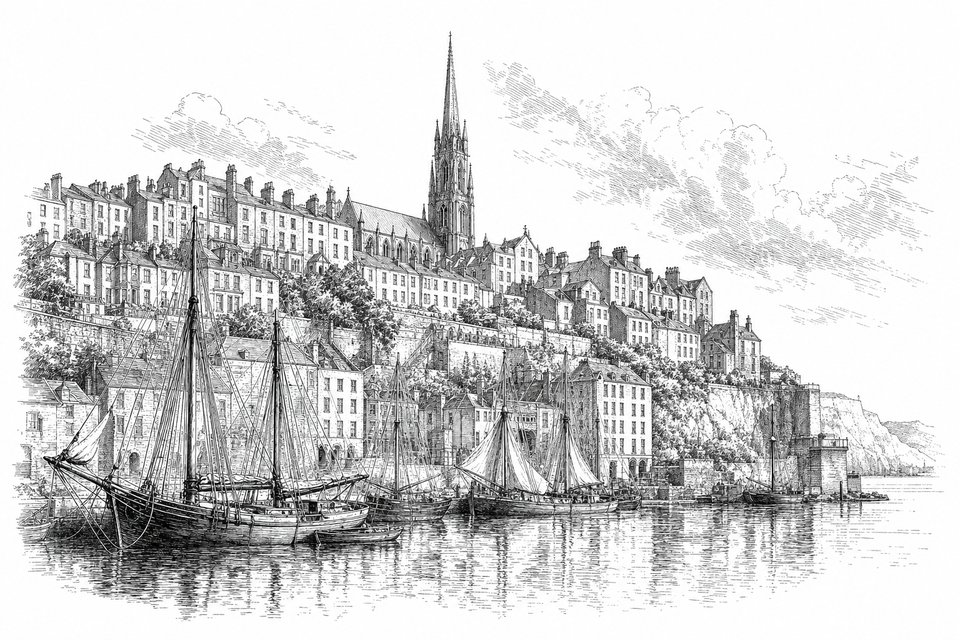
Cobh is that town, twenty-five minutes from the city by road or rail. It rises in tiers of tall terraced houses up a hill too steep to build on comfortably, with St Colman's Cathedral above them, and the composition from the water is the one that appears on the postcards. It was the departure point for a very large proportion of Irish emigration across the nineteenth and twentieth centuries, and the final port of call of the Titanic. Both are interpreted properly rather than sentimentally, which on this subject is worth something.
Spike Island sits in the harbour and is reached by ferry from Cobh. It has been a monastery, a fortress and a prison, and it is the prison that the visit is about. It takes most of a half day including the crossing and it is the best single historical site on the south coast.
Crosshaven, on the western side, is where the harbour becomes a sailing harbour rather than a commercial one, and it holds a claim to the oldest yacht club in the world. It is a short trip and a pleasant one rather than an essential.
Section 3Kinsale, and the start of the route
Kinsale is forty minutes south of the city and it is where the Wild Atlantic Way begins. That matters practically: an itinerary running the route northward starts here, so the south coast is the first day of the drive rather than an excursion away from it, and anyone planning the Wild Atlantic Way route from Dublin has a choice between starting at the top in Donegal or the bottom in Cork.
The town itself is a walled harbour town of narrow streets on a hillside above an inlet, with a food reputation that is deserved and long-standing rather than recent. It is small enough to see in a couple of hours and pleasant enough to stay in for two nights.
Charles Fort, a twenty-minute walk or a short drive around the harbour, is a star-shaped seventeenth-century artillery fort in remarkably complete condition. It is the best of the harbour fortifications and the one worth the time.
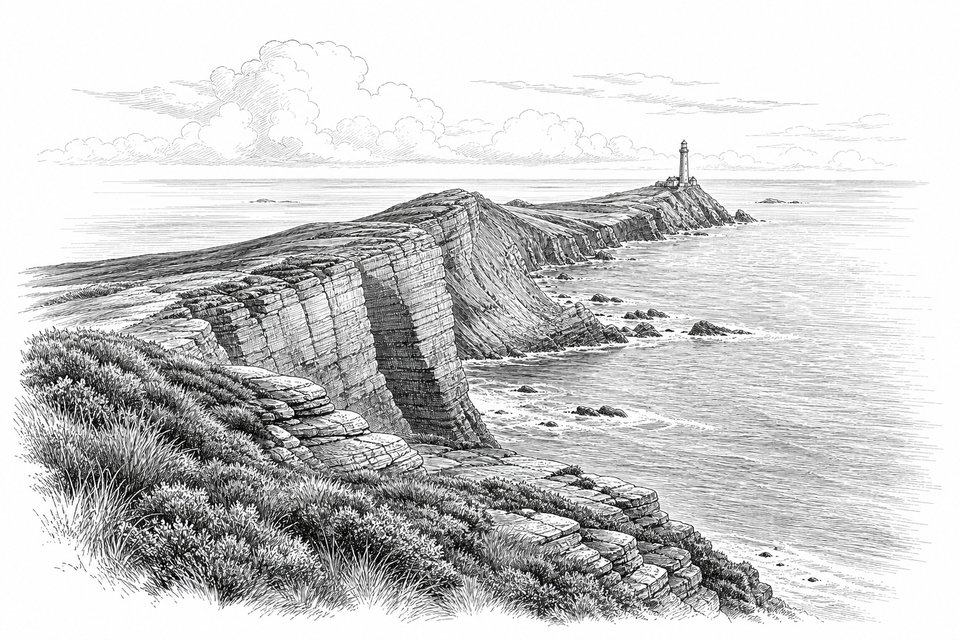
South of the town, the Old Head of Kinsale is a long narrow promontory with a lighthouse at the end and a signal station on the way. The tip is on private land, and the approach and the cliffs on either side are the point regardless.
Section 4West Cork, and the three peninsulas
West of Clonakilty the coast changes character. The towns thin out, the road starts following inlets rather than crossing them, and three peninsulas reach out into the Atlantic, each with a different reason to drive it.
The three west Cork peninsulas, with what each is for and how long the drive realistically takes.
| Peninsula | Drive | Go for | Note |
|---|---|---|---|
| Mizen | Half a day | The southernmost point, the signal station bridge | The most visited of the three, which is not saying much |
| Sheep’s Head | Half a day | Emptiness, and a walking route the length of it | Narrow throughout; the least infrastructure |
| Beara | A full day | The best of the three, and a mountain pass | Shared with Kerry; the Healy Pass crosses the spine |
Mizen Head is the southernmost point of mainland Ireland, and the approach ends at a signal station reached across a concrete arched footbridge over a chasm, which is the photograph people come for. The road out is ordinary; the last two kilometres are not.
Sheep's Head is the narrowest and least developed, a single road out and back along a ridge with water on both sides. There is a long-distance walking route along it, and there is very little else, which is precisely the appeal.
Beara is the largest and the best, shared between Cork and Kerry, with a mountain range down the middle of it rather than a ridge. The Healy Pass crosses that range in a series of hairpins and is one of the genuinely fine short drives in Ireland. Beara is also where the south coast most closely resembles the west, and a day is the minimum rather than a generous allowance.
Two smaller notes. Bantry and Glengarriff are the natural bases for Beara and Sheep's Head, and staying in one of them removes an hour and a half of driving from each end of the day. And the islands off this coast, Cape Clear and Sherkin among them, run on the same seasonal ferry logic set out for the Aran Islands: check the return sailing before the outbound one.
Section 5Getting there, and getting around
By air. Cork Airport is close to the city and serves the United Kingdom and a reasonable spread of Europe. For anything long-haul the connection is through a European hub or through Dublin, which is set out in flying from Ireland. For a visitor whose trip is the south coast rather than the whole country, flying into Cork rather than Dublin removes about five hours of driving from the itinerary at both ends.
By road from Dublin. Motorway most of the way, and about two and a half to three hours. This is one of the few Irish journeys where the map time and the real time broadly agree, because it is nearly all M-class road.
Around the region. A car, in practice. The city is walkable and the harbour towns are reachable by rail and bus, but the peninsulas are not served at any useful frequency and they are the reason to come west. The roads themselves are wider and better than the equivalent in Kerry or Connemara, which makes this a sensible place to start if you are new to driving in Ireland before taking on the narrower western sections.
Section 6What is open when
The south coast has a longer usable season than the west, and the reason is shelter rather than temperature. The harbours are protected, the towns are large enough to function out of season, and the road network does not depend on a single coastal route that becomes unpleasant in a gale.
April to October is comfortable throughout. July and August are the busy months and on this coast that means the towns rather than the peninsulas; Kinsale in August is full and Sheep's Head in August is not. November to March keeps the city, the harbour and Kinsale entirely viable, while the island ferries reduce and some of the smaller peninsular attractions close.
The specific thing to check out of season is the ferries and the visitor sites at the far end of the peninsulas, both of which run to shorter hours or shut. The towns do not, and neither does the driving.
Section 7The evening
Cork is a small city with a genuinely disproportionate amount going on in it, and most of it is within the same twenty minutes of walking as everything else. Live music is ordinary rather than staged for visitors, the food is better than the city's size would predict, and the whole centre is compact enough that an evening does not require planning or a taxi.
For anyone whose interest runs to table gaming, the position in Cork is the same as it is nationally and it is not what most visitors expect: there are no licensed casinos in Ireland in the sense the word is used elsewhere, and table gaming happens in private members' clubs. One club in the city was verified as operating for this site; the Cork guide covers what that means at the door, and the national picture covers why the category exists in that form at all.
Beyond the city, the evening is the towns. Kinsale, Clonakilty, Bantry and Skibbereen all have more happening on a wet Tuesday in October than their populations suggest, and on this coast that is generally the difference between a base worth staying in and a place to sleep.
Common questions
Is Cork worth visiting, or is it just the airport?
Worth visiting on its own terms, and it is the natural base for the whole south coast. The city centre is compact and walkable, the harbour towns are within half an hour, and west Cork begins about an hour away. Anyone treating it as a transit point is skipping the least crowded good coastline in the country.
How many days does the south coast need?
Two days covers the city, the harbour and Kinsale properly. Five gets you west Cork as well, which is where the coastline stops being pretty and starts being remarkable. One day is the city and one harbour town, and that is a real trip rather than a compromise.
Where does the Wild Atlantic Way start?
At Kinsale, in County Cork, which is its southern end. Most itineraries run it northward from there to Donegal, which means the south coast is the beginning of the route rather than a detour off it, and the first day is one of the gentler ones.
What is the difference between the south coast and the west?
Scale and shelter. The west is bigger, barer and more dramatic, and the weather has nothing between it and the Atlantic. The south is greener, the harbours are deep and protected, the towns are larger and closer together, and the driving is easier. It also has considerably fewer visitors for comparable scenery.
Is Cobh worth a visit if I have already seen Cork city?
Yes, and it is a different thing rather than more of the same. It is a Victorian harbour town in tiers up a steep hill, with a cathedral above it and one of the deepest natural harbours in the world below. It was the last European port of call for the Titanic and the point of departure for a very large share of Irish emigration, and both are properly interpreted there.
Can you reach west Cork without a car?
With difficulty, and not on a schedule. Buses connect the larger towns and do not serve the peninsulas at useful frequencies. The peninsular roads are the reason to go, so this is one of the parts of Ireland where a car is close to a requirement.